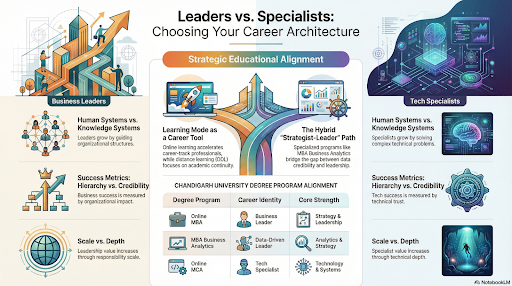
The future of work is not being shaped by industries alone — it is being shaped by two fundamentally different career identities. One is built around leadership, influence, and organisational decision-making. The other is built around expertise, innovation, and technical mastery. These are not job roles. They are career architectures — long-term patterns of how professionals grow, evolve, and define success over decades.
As India’s education and career ecosystem matures, this distinction is becoming clearer than ever. Institutions such as Chandigarh University are responding to this shift by building learning ecosystems that support both leadership-driven careers and specialisation-driven careers — recognising that modern professionals no longer fit into a single mould.
By 2026 and 2030, this divide will deepen. Business careers will increasingly evolve around strategy, governance, leadership influence, and organisational systems, while technology careers will evolve around innovation, system design, domain mastery, and technical authority. Understanding this difference early is no longer optional — it is essential for long-term career clarity.
- Two Different Ways Careers Grow
- Business Leaders: Careers Built on Influence and Responsibility
- Tech Specialists: Careers Built on Expertise and Innovation
- Why Education Must Reflect Career Identity
- Learning Mode as a Career Tool
- Online Learning vs ODL (Distance Learning): Career Impact Comparison
- Business Pathway: Online MBA at Chandigarh University
- Hybrid Leadership Path: MBA Business Analytics
- Tech Specialist Pathway: Online MCA at Chandigarh University
- Career Architecture Comparison
- FAQs
- Final Reflection
Two Different Ways Careers Grow
A business career and a technology career may start at similar points, but they grow in completely different directions over time.
A business career is built around human systems. Growth comes from learning how organisations function, how decisions are made, how people are managed, and how value is created at scale. Over time, professionals in this pathway move away from execution and into responsibility ownership. Their value increases not because they perform tasks well, but because they guide systems, influence structures, and shape outcomes.
A technology career, in contrast, is built around knowledge systems. Growth comes from depth, not scale. Professionals in this pathway gain value by solving complex problems, designing systems, and building innovations that others depend on. Their authority does not come from managing people — it comes from technical trust. Their influence is created through expertise, not hierarchy.
These two identities create very different professional lives, decision patterns, and success metrics.
Business Leaders: Careers Built on Influence and Responsibility
Business leaders evolve by expanding their sphere of responsibility. Their careers move from doing work to directing work, and then to shaping systems. Over time, they become responsible not just for outcomes, but for people, performance, culture, strategy, and institutional direction.
Their professional growth is defined by:
- decision-making authority
- leadership trust
- organisational influence
- strategic responsibility
- long-term institutional impact
Success in this pathway is not measured by how well someone performs tasks — it is measured by how well they shape organisations. Their careers evolve through leadership positions, governance roles, strategic functions, and organisational stewardship.
These careers produce managers, executives, strategists, founders, policy leaders, and institutional decision-makers.
Tech Specialists: Careers Built on Expertise and Innovation
Tech specialists evolve by deepening knowledge and authority. Their careers move from learning systems to building systems, and then to designing systems that others depend on. Over time, they become responsible not for people, but for complexity, reliability, and innovation.
Their professional growth is defined by:
- technical mastery
- system responsibility
- innovation contribution
- problem-solving leadership
- domain authority
Success in this pathway is not measured by hierarchy — it is measured by technical credibility. Their careers evolve through specialisation, innovation roles, architecture positions, system leadership, and domain expertise.
These careers produce engineers, architects, specialists, innovators, researchers, and technical leaders.
Why Education Must Reflect Career Identity
The biggest mistake students and professionals make is choosing education based on qualification labels, not career identity. Many people train for leadership when they are wired for specialisation. Many people train for specialisation when they are wired for leadership.
This mismatch creates long-term dissatisfaction, career stagnation, and identity conflict.
This is why modern universities are redesigning learning models. Programs from Chandigarh University, both online and distance, reflect this shift — offering flexible structures that allow learners to choose learning formats based on career direction, rather than convenience.
As online degree courses in India mature, education is no longer about physical classrooms — it is about career alignment.
Have something specific in mind?
You can reach out to us anytimeLearning Mode as a Career Tool
The learning format is no longer neutral. It actively shapes career evolution.
Professionals on leadership paths need learning systems that integrate with work,
responsibility, and organisational growth.
Professionals on technical paths need learning systems that integrate with skill
development, practice, and innovation cycles.
This makes learning mode a career decision, not just an academic one.
Online Learning vs ODL (Distance Learning): Career Impact Comparison
| Dimension | Online Learning Mode | ODL (Open & Distance Learning) Mode |
|---|---|---|
| Learning Experience | Live sessions, digital interaction, structured engagement | Self-paced study, independent learning |
| Career Integration | Strong integration with working life | Limited professional integration |
| Skill Application | High practical exposure | Conceptual focus |
| Faculty Interaction | Regular | Minimal |
| Professional Networking | Strong | Limited |
| Learning Structure | Continuous learning ecosystem | Term-based academic structure |
| Career Alignment | Working professionals, career-track learners | Academic continuity learners |
| Industry Readiness | High | Moderate |
| Flexibility Type | Time flexibility | Location flexibility |
| Long-Term Impact | Career acceleration focused | Degree completion focused |
This distinction matters because career growth depends on learning structure, not just degree recognition.
Business Pathway: Online MBA at Chandigarh University
The Chandigarh University Online MBA is structurally aligned with the business leadership pathway. It supports professionals who aim to grow into managerial, leadership, and strategic roles rather than technical specialisation roles.
Its design supports:
- leadership development
- managerial thinking
- strategic understanding
- organisational systems learning
- business decision capability
The CU Online MBA fees of Rs 1,65,000 place it within an accessible range for professionals seeking leadership growth without disrupting their careers.
Hybrid Leadership Path: MBA Business Analytics
The Chandigarh University MBA Business Analytics fees of Rs 1,80,000 represent a hybrid career identity — professionals who lead through data-driven decision-making.
This pathway creates leaders who combine:
- management capability
- analytical reasoning
- strategic interpretation
- business intelligence understanding
These professionals operate at the intersection of leadership and data — shaping strategy through insight, not authority alone.
Tech Specialist Pathway: Online MCA at Chandigarh University
The Chandigarh University Online MCA is aligned with the technology specialisation pathway. It supports learners who want careers built on system design, software development, digital architecture, and technical innovation.
This pathway supports growth into:
- technical leadership
- system architecture
- digital product development
- innovation roles
- specialised technology careers
The Chandigarh University MCA fees (Rs 1,16,250) position it as a long-term technical career investment for learners building deep specialisation.
Career Architecture Comparison
| Dimension | MBA | MBA Business Analytics | MCA |
|---|---|---|---|
| Career Identity | Business leader | Data-driven leader | Tech specialist |
| Growth Logic | Influence expansion | Insight-based leadership | Expertise deepening |
| Core Strength | Strategy & leadership | Analytics & strategy | Technology & systems |
| Authority Source | Organisational trust | Data credibility | Technical mastery |
| Long-Term Path | Leadership → governance | Strategy → leadership | Architecture → innovation |
| Professional Identity | Leader | Strategist–leader hybrid | Specialist–innovator |
FAQs
Yes. Chandigarh University’s online degrees follow recognised digital education frameworks and regulatory standards.
The CU Online MBA fees are Rs 1,65,000.
The CU Online MCA fees are Rs 1,16,250.
The MCA follows applicable regulatory frameworks for technical education programs.
Yes. The programs are structured for working professionals and career-track learners.
Neither is universally better. Online learning suits working professionals and career acceleration paths, while distance education suits academic continuity and flexible access needs. The right choice depends on career goals.
Final Reflection
The future of careers will not be defined by industries alone. It will be defined by identity.
Some people are wired to lead systems.
Some people are wired to build systems.
Both are powerful. Both are necessary. Both shape the future.
The only real failure is choosing education without understanding who you are becoming — because between 2026 and 2030, success will not depend on what you studied — but on whether your learning journey aligned with your true career architecture.