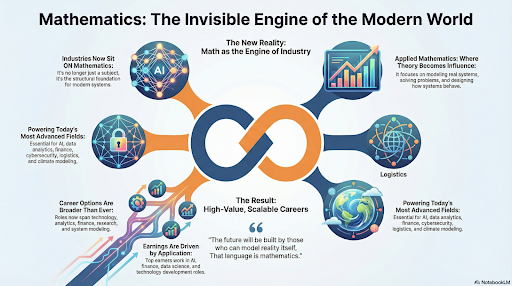
Mathematics rarely appears in the foreground of modern technology, yet it quietly powers almost everything that defines contemporary life. Artificial intelligence, financial systems, climate modelling, healthcare technologies, logistics platforms, cybersecurity systems, and digital infrastructure all operate on invisible mathematical foundations.
Behind every intelligent system lies a model. Behind every model lies mathematics.
This is why mathematics today can no longer be seen as just an academic subject. It has become a structural force — an invisible engine that drives modern technology, industry, and innovation. Choosing mathematics as an advanced study is no longer about choosing theory over application. It is about choosing access to the deepest layers of the modern technological world.
- Mathematics as Career Infrastructure
- From Academic Discipline to Industry Engine
- Mathematics in the Data and Technology Economy
- Applied Mathematics and Real-World Impact
- Work-Linked Mathematics Education
- Earnings, Value, and Career Scalability
- Research Pathways and the PhD Horizon
- FAQs
- Final Reflection
Mathematics as Career Infrastructure
Modern economies no longer run on machines alone — they run on models. These models guide decisions, predictions, risk assessments, automation, and optimisation across sectors.
At the Core of These Systems Lies Mathematics.
This is what has transformed mathematics into a career infrastructure, not just a discipline. It now supports multiple industries simultaneously and forms the backbone of modern systems, such as:
- technology platforms and AI systems
- data ecosystems and analytics engines
- financial and economic modelling
- research and innovation frameworks
- engineering and simulation systems
- healthcare and climate modelling infrastructures
In this new reality, mathematics does not sit inside industries.
Industries sit on mathematics.
This shift has created entirely new applied mathematics jobs that did not exist a decade ago — roles focused on modelling, prediction, optimisation, simulation, and system design rather than classroom instruction alone.
From Academic Discipline to Industry Engine
Mathematics has moved out of isolation. It no longer lives only in classrooms, lecture halls, or research journals. It now lives inside industries.
This transformation has reshaped MSc Mathematics for industry pathways, where mathematical training connects directly with real-world systems, business problems, and technological development. Modern mathematicians work inside:
- Data platforms
- AI systems
- Analytics environments
- Financial technologies
- Research labs
- Modelling frameworks
- Digital infrastructure systems
Where can a mathematician work? This question now has a broad, practical answer: almost anywhere complex systems exist.
As a result, career options after MSc Mathematics are no longer narrow or academic-only. They now span technology, analytics, finance, research, modelling, innovation, and digital infrastructure roles.
Mathematics in the Data and Technology Economy
The data economy is fundamentally mathematical. Algorithms, machine learning systems, predictive platforms, and analytics engines are built on mathematical structures.
This has created strong growth in:
- data mathematics careers
- mathematics jobs in analytics
- modelling and simulation roles
- algorithm development roles
- AI system design roles
- decision science careers
The rise of mathematics and data science careers reflects a deeper reality: technology does not replace mathematics — it amplifies it. Mathematics is no longer supporting technology. It is structuring it.
Applied Mathematics and Real-World Impact
Applied mathematics is where theory becomes influence. Instead of focusing only on abstraction, applied mathematics focuses on:
- Modelling Real Systems
- Solving Real-World Problems
- Predicting Outcomes
- Optimising Processes
- Designing Functional Systems
This makes applied mathematics central to industries such as finance, logistics, healthcare, climate science, energy systems, AI development, defence technologies, and industrial automation.
Applied mathematicians do not just study systems — they design how systems behave.
Work-Linked Mathematics Education
The emergence of Work-Linked MSc Mathematics models reflects this industry integration. Mathematics education is increasingly connected to:
- industry projects
- applied research
- analytics platforms
- modelling environments
- professional problem-solving contexts
This creates graduates who are not only academically capable but also professionally deployable in real industry environments.
Have something specific in mind?
You can reach out to us anytime.Earnings, Value, and Career Scalability
When students ask how much mathematicians earn, the answer depends less on the degree and more on the domain of application.
Mathematicians working in:
- Analytics and data science
- AI and modelling systems
- Finance and quantitative research
- Technology development
- Simulation and optimisation systems
earn more than those in purely academic pathways. Income growth is driven by:
- system responsibility
- complexity of work
- industry integration
- domain specialisation
- technical authority
Mathematics offers one of the strongest long-term scalability curves among all science disciplines.
Research Pathways and the PhD Horizon
For students asking what they can do with a PhD in mathematics, the answer is no longer limited to teaching and academia.
Modern PhD mathematicians move into:
- advanced research labs
- AI development ecosystems
- algorithm architecture roles
- data science leadership
- policy modelling systems
- innovation and deep-tech environments
A PhD today represents knowledge leadership, not just academic qualification.
FAQs
Graduates can work in analytics, data science, finance, research, modelling, technology systems, education, and applied industry roles.
Roles include data analyst, quantitative researcher, systems modeller, analytics consultant, financial analyst, AI support roles, and research associate positions.
Yes. Modern industries actively hire mathematics graduates for data systems, modelling, analytics, AI, finance, and optimisation roles.
Earnings depend on sector and specialisation. Mathematicians in analytics, data science, finance, and technology typically earn higher than academic-only roles.
Applied mathematics graduates work in modelling, simulation, analytics, operations research, finance, logistics, AI systems, and industry research roles.
Options include data science, AI, analytics, quantitative finance, applied research, and industry-focused PhD programmes.
Yes, if the programme is recognised and meets regulatory standards, it is valid for academic and research progression.
Post-PhD pathways include research leadership, industry research roles, AI development, policy research, academic careers, and innovation leadership roles.
Final Reflection
Mathematics does not dominate headlines. It does not trend on social media. It does not market itself.
Yet it powers:
- Every algorithm
- Every AI system
- Every data platform
- Every financial engine
- Every predictive model
- Every optimisation framework
- Every digital infrastructure system
Mathematics is not visible — but it is indispensable. Choosing mathematics as an advanced study is not choosing a subject. It is choosing a position in the architecture of the future.
Because the future will not be built only by coders or engineers — it will be built by those
who can model reality itself.
That language is mathematics.