For decades, students chose degrees based on subject, reputation, and location. The mode of study was rarely the deciding factor. In 2026, that logic no longer holds. The format through which a bachelor's or master's degree is pursued—online learning, open and distance learning (ODL), or work-linked programs—increasingly shapes not only convenience, but skill development, career alignment, and long-term professional identity.
The shift is structural. Work has become hybrid. Skill cycles are shorter. Career transitions are more frequent. As a result, the question is no longer just what should I study? How should I study in a way that fits the life I am building?
Universities that recognise this shift design learning formats intentionally rather than treating them as delivery alternatives. Institutions such as Chandigarh University reflect this broader transition by structuring bachelor's and master's pathways across multiple formats to serve different learner realities.
Takeaway: In 2026, choosing the right mode of study is a strategic decision, not a logistical one.
- Why online learning has become central to bachelor's and master's degrees
- How open and distance learning (ODL) differs from online programs
- Why work-linked programs represent a different philosophy of education
- Does geography still matter in 2026?
- How bachelor's and master's choices differ across formats
- Is validity still a concern in 2026?
- What about cost and accessibility?
- Why the mode of study will matter even more beyond 2026
- Conclusion
Why online learning has become central to bachelor's and master's degrees
Online learning is no longer an emergency solution. It has evolved into a structured academic ecosystem supported by regulated frameworks and digital infrastructure.
When students explore Chandigarh University Online Programs , they are not simply looking for flexibility. They are evaluating whether the learning format allows:
- Consistent academic structure
- Digital interaction and feedback
- Self-paced but semester-based progression
- Integration with ongoing work or preparation for competitive exams
The Chandigarh University online fees structure is typically designed to reflect modular, semester-based learning rather than residential campus cost structures. This difference illustrates how format reshapes cost logic as well.
Online learning supports students who:
- Want to pursue a bachelor's degree while preparing for competitive examinations
- Are already working and pursuing a master's degree for career advancement
- Need geographic mobility without interrupting education
Yes. Online degrees offered under UGC-approved frameworks are valid when delivered in compliance with regulatory guidelines and awarded by a recognised university.
Controlled contradiction
Online learning is often perceived as "easier." In practice, it demands stronger self-discipline, time management, and digital engagement than traditional formats.
How open and distance learning (ODL) differs from online programs
Open and distance learning is frequently confused with fully online formats. While both reduce the need for daily campus attendance, their structure differs.
Chandigarh University Distance Education programs typically follow a model that includes:
- Printed or digital self-learning materials
- Defined academic sessions
- Periodic contact classes or support sessions
- Structured term-end examinations
ODL works particularly well for learners who:
- Prefer guided self-study
- May not require frequent live digital interaction
- Seek flexibility without a continuous online presence
For bachelor's students in Punjab, Delhi, or other regions, distance education provides academic continuity without relocation. The question is not whether one format is superior, but whether it aligns with the learner's context.
Yes. Distance education programs are designed to serve learners beyond immediate campus geography, subject to eligibility criteria and regulatory norms.
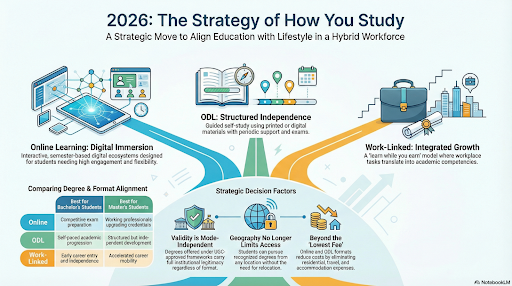
Takeaway: ODL is structured independence; online learning is interactive digital immersion.
Why work-linked programs represent a different philosophy of education
Among the three formats, CU Work Linked Programs stand apart because they integrate employment with structured academic progression.
Work-linked programs are not merely flexible degrees. They are designed to:
- Combine professional experience with academic evaluation
- Allow students to earn while learning
- Translate workplace tasks into assessed competencies
This model particularly benefits:
- Students entering the workforce early
- Individuals from regions where financial independence is essential
- Those who value applied learning alongside theoretical grounding
Work-linked formats reshape the traditional sequence of "study first, work later." Instead, they build simultaneous growth.
Takeaway: Work-linked learning reduces the gap between classroom knowledge and workplace performance.
Does geography still matter in 2026?
Students often search for terms like Chandigarh University, Chandigarh, or Chandigarh University in Delhi, reflecting a long-standing belief that proximity determines access. In 2026, learning formats increasingly weaken geographic dependency.
A student in Delhi can pursue an online bachelor's degree. A working professional in Punjab can enrol in a master's program without relocation. Geographic identity still matters for institutional presence—but not necessarily for academic access.
Yes. When awarded under UGC-approved regulations, online degrees are valid across India, including Delhi.
Geography shapes the community. Mode shapes access.
How bachelor's and master's choices differ across formats
The decision to pursue a bachelor's degree versus a master's degree also affects format suitability.
For bachelor's students:
- Online learning supports competitive exam preparation alongside study.
- Distance learning supports self-paced academic progression.
- Work-linked programs support early career entry.
For master's students:
- Online programs support working professionals upgrading credentials.
- ODL supports structured but independent academic development.
- Work-linked models accelerate career mobility.
The format becomes a career design tool, not merely a study arrangement.
Feel free to connect with us for complete details and guidance
Get in TouchIs validity still a concern in 2026?
Despite regulatory clarity, students still ask about recognition. Questions such as Is Chandigarh University Online Degree Valid? reflect lingering uncertainty around online education.
Validity today depends on:
- Recognition of the university
- UGC approval for the mode of delivery
- Compliance with academic standards
When these criteria are met, the degree carries institutional legitimacy regardless of format.
For working professionals, structured online and work-linked programs can offer academic progression without career interruption, making them suitable options depending on individual goals.
Takeaway: Mode does not reduce legitimacy. Lack of regulation does. In 2026, regulations exist.
What about cost and accessibility?
Fee structures often differ across formats due to infrastructure requirements. Queries around Chandigarh University online fees usually arise from comparisons with residential programs.
Online and ODL formats:
- Eliminate relocation costs
- Reduce accommodation expenses
- Offer flexible semester-based payments
However, cost should not be evaluated in isolation. Learners must consider:
- Opportunity cost of leaving employment
- Travel and living expenses
- Long-term career impact
The most economical option is not always the lowest fee—but the format that sustains progression.
Fees vary by program and structure and are typically detailed in the official brochure or university website.
Students can access official brochures through the university's website or authorised academic portals, where detailed program structures and eligibility information are provided. Transparency remains central to informed choice.
Why the mode of study will matter even more beyond 2026
As careers become multi-stage journeys rather than single-track paths, learners will return to higher education multiple times. The format must accommodate:
- Career transitions
- Skill upgrades
- Geographic mobility
- Financial sustainability
In this context, the presence of institutions like Chandigarh University, Punjab, offering diversified formats signals a structural shift in how education adapts to societal change. Online learning, distance education, and work-linked programs are not competitors. They are responses to different life realities.
Controlled contradiction
The assumption that one "best" mode exists ignores the complexity of modern learners' lives. What is optimal for an 18-year-old undergraduate may not serve a 32-year-old working professional.
Conclusion
In 2026, the mode of study has become a defining element of educational success. Online learning enables digital immersion and career continuity. Open and distance learning provides structured independence. Work-linked programs integrate employment with academic growth. The decision between these formats is no longer secondary to subject choice—it shapes cost, access, skill development, and professional identity.
As higher education adapts to evolving work environments and learner expectations, selecting the appropriate mode of study becomes a strategic act. The future of bachelor's and master's education lies not in replacing one format with another, but in aligning learning design with the lived realities of students across regions, professions, and life stages.