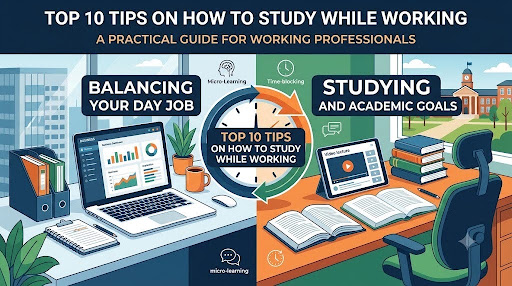
A practical guide for working professionals balancing a full-time job with academic goals
Balancing a job and a degree is no longer a rare arrangement; it has become the default path for a growing number of working professionals who want to upskill, switch careers, or simply finish a qualification they paused earlier. What separates those who complete their studies successfully from those who burn out midway is rarely intelligence or ambition. It is almost always structure the small, repeatable habits that protect study time from being swallowed by work demands.
This guide lays out ten practical, field-tested tips for managing academics alongside a full-time role, along with a real-world look at how this plays out for someone early in their career, and a ready-to-use daily to-do list to keep both sides of the balance on track.
The Ten Tips
1. Time-block your calendar in advance
Treat study sessions like unmissable meetings. Blocking specific hours on a calendar, even 45 minutes at a time, makes study time visible and protects it from being overtaken by last-minute work requests.
2. Use micro-learning sessions during work breaks
Short, focused bursts of learning during lunch breaks or between meetings add up over a week. Reviewing flashcards, short video lectures, or summary notes in 10–15 minute windows keeps momentum without requiring large blocks of free time.
3. Prioritise tasks using an urgent-important matrix
Not every work task or study deadline carries equal weight. Sorting tasks into urgent-important categories helps decide, on any given evening, whether an office deliverable or a course assignment should come first.
4. Communicate the study schedule to managers and teams
Colleagues and supervisors are generally more accommodating when they know a study commitment exists. Being upfront about exam periods or assignment deadlines in advance often results in more flexibility around deadlines or meeting timings.
5. Batch similar academic tasks together
Switching between reading, writing, and problem-solving repeatedly wastes mental energy. Grouping similar tasks all reading in one sitting, all assignment writing in another reduces the cognitive cost of constantly changing modes.
6. Protect one consistent daily study window
Consistency beats intensity. A fixed one-hour window at the same time every day builds a habit loop that requires less willpower over time than sporadic, unpredictable study sessions.
7. Use commute and wait time for passive learning
Audio lectures, podcasts, or recorded classes turn otherwise unproductive commute or waiting time into extra study hours without competing with either work or personal time.
8. Avoid multitasking between work deliverables and coursework
Attempting to draft a work report and a course assignment in the same sitting typically produces weaker output on both. Full attention on one task at a time, even briefly, produces better results than divided attention over a longer period.
9. Build in recovery time to prevent burnout
Working professionals studying part-time are especially prone to burnout because there is no natural break between the two commitments. Scheduling short recovery periods a walk, a proper lunch break, an evening off once a week is what makes the routine sustainable over months, not just weeks.
10. Review weekly progress and adjust the plan
A study plan drafted once at the start of a term rarely survives unchanged. A short weekly review of what got done, what slipped, and what needs to shift keeps the plan realistic instead of aspirational.
What This Looks Like in Practice
Consider a typical first-year intern balancing an entry-level role with an ongoing degree. Early mornings are usually spent reviewing the previous day's coursework before office hours begin. Through the day, short breaks are used for quick revision rather than idle scrolling, and any spare capacity between assigned tasks goes toward reading ahead. Evenings are reserved for one focused study block, followed by a short recovery period before the next workday begins. None of this requires exceptional discipline it requires a repeatable structure that removes the need to decide, every single day, when studying is supposed to happen.
A Daily To-Do List for Managing Work and Study
A simple day-part checklist helps keep both work responsibilities and academic goals visible, rather than letting one quietly crowd out the other:
Morning (Before Work)
- Review the previous day's study notes for 10–15 minutes
- Check the day's top 3 work priorities
- Note any upcoming academic deadlines for the week
During Work Hours
- Use short breaks for micro-learning instead of idle time
- Keep coursework materials accessible for spare moments
- Avoid switching between work tasks and study tasks mid-task
Evening (After Work)
- Complete one focused, uninterrupted study block
- Batch similar academic tasks (reading, writing, problem sets)
- Prepare the next day's work priorities before logging off
End of Week
- Review what was completed versus what was planned
- Adjust the following week's time-blocks if needed
- Schedule one recovery break with no work or study obligations
A Framework for Sustainable Balance: The 4-Block Focus Model
Rather than treating work and study as competing priorities, the 4-Block Focus Model divides a working day into four distinct zones:
- Work Focus
- Micro-Learning
- Deep Study
- Recovery
Each zone is assigned a clear purpose and a realistic time allocation. The model's core principle is that these zones should never overlap: work focus time is protected from study intrusions, and deep study time is protected from work interruptions. This separation, more than any single productivity technique, is what prevents the fatigue that typically causes working learners to abandon their studies midway.
Comparing Common Study Techniques
Different techniques suit different work environments. The comparison below helps match a technique to a specific job type rather than adopting one approach by default:
| Technique | Best Suited For | Limitation |
|---|---|---|
| Time-blocking | Fixed-shift jobs with predictable hours | Breaks down if work hours are irregular |
| Micro-learning | High-pressure roles with frequent short breaks | Slower progress on dense or technical topics |
| Weekend-intensive study | Roles with strict weekday schedules | Risk of burnout without weekday reinforcement |
Why These Habits Matter
- Prevents academic deadlines from colliding unexpectedly with work deadlines
- Reduces the mental load of constantly renegotiating priorities
- Builds a sustainable routine instead of relying on last-minute cramming
- Improves the quality of both work output and academic performance
- Lowers the risk of dropping out midway due to burnout
Frequently Asked Questions
There is no fixed number, but most working learners find 1–2 focused hours on weekdays, supplemented by longer sessions on weekends, to be sustainable over the long run.
Both work, depending on personal energy patterns. Mornings tend to offer sharper focus with fewer distractions, while evenings allow reflection on the day's wohhhrk experiences.
Scheduled recovery time is essential; even one short break a week without any work or study obligation significantly reduces the risk of long-term fatigue.
Yes, in most cases. Managers who are aware of study commitments are often more flexible around deadlines during exam periods or assignment weeks.
Inconsistent scheduling is the most common cause, not the lack of ability. A protected, repeatable study window tends to solve this more effectively than occasional long study sessions.