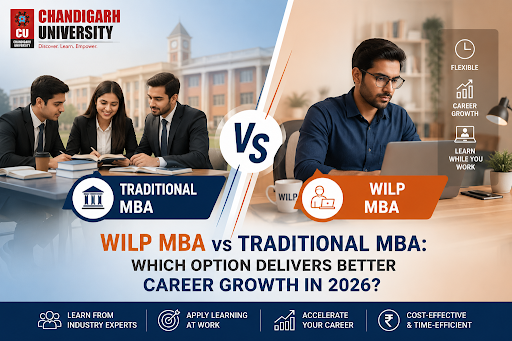
Both are MBAs. What separates them is what they ask of you and what they give back
The postgraduate management education market has diversified considerably, and the professionals navigating it today are choosing between genuinely different models, not just different institutions offering the same experience.
That diversification has been driven by a real problem. The traditional MBA was built for a specific kind of student: someone who could set aside two years of professional life, bear the financial and opportunity costs of full-time residential study, and rely on campus placements as the primary mechanism for career progression. For a large and growing proportion of the people who actually need and want an MBA, none of those conditions applies.
The comparison between WILP and traditional MBA is therefore not purely a question of which produces better outcomes in the abstract. It is a question of which model is designed for the kind of professional you actually are given your current career stage, your financial situation, your learning style, and what you are trying to achieve. Framed that way, the comparison becomes considerably more useful.
Every significant shift in management education has been driven by a mismatch between what a growing population of professionals needed and what the incumbent model could deliver. The WILP model is the current response to exactly that mismatch, and its growth reflects genuine demand, not novelty.
- What Each Model Is Actually Optimised For
- The Professionals Who Are Genuinely Torn Between These Options
- How to Decide Honestly
- What a WILP MBA Is Designed to Deliver
- What the WILP MBA Curriculum Covers
- MBA Career Growth: The Forward View
- Eligibility, Investment, and How to Apply
- Key Takeaways
- Frequently Asked Questions
What Each Model Is Actually Optimised For
The traditional MBA is optimised for career transformation through immersion. It works best when a professional wants to make a significant industry or function switch, has the financial means to absorb two years without income, and is targeting roles in sectors where campus brand and placement relationships are the primary hiring channel. Investment banking, strategy consulting, and a narrow band of corporate leadership programmes fit this profile. For those specific goals, the traditional model remains a strong choice; brand, network, and placement infrastructure matter enormously in those tracks.
The work-integrated learning program MBA is optimised for something different: career acceleration within a professional's existing trajectory. It is built for the professional who does not want to leave their career; they want to upgrade it. The academic learning is designed to connect with real work happening in real time, which means the frameworks being studied have immediate application contexts, and the professional's workplace becomes part of the learning environment rather than something to return to after graduation.
One of the biggest gaps in how this comparison is usually framed is the failure to distinguish between transformation and acceleration as career goals. Both are legitimate. But they call for different interventions. A professional who is well-positioned in a field they want to lead is not well-served by a model that removes them from that field for two years. The work-linked degree program is built precisely for that professional.
The prestige premium of a traditional MBA is most valuable in a narrow set of career contexts. For the large majority of management professionals, those building careers in operations, sales leadership, marketing, HR, and general management across Indian industries, the WILP model consistently delivers comparable career outcomes at a fraction of the cost and without the career interruption.
The Professionals Who Are Genuinely Torn Between These Options
The professionals most likely to be comparing these two models are not fresh graduates. They are people who have been working for three to eight years, have accumulated real professional capital, and are now at a point where the absence of a postgraduate management credential is beginning to constrain what they can access. The question they are asking is not whether to do an MBA; they have already decided that. The question is how to do it without undoing the professional progress they have already made.
For these professionals, the prospect of pursuing an MBA while working is not a compromise it is often the only arrangement that makes coherent financial and career sense. Leaving employment for two years means not only the cost of fees but the loss of income, the loss of professional momentum, and in many cases, the loss of a role that took years to build. The arithmetic rarely works in favour of interruption unless the destination is a very specific set of high-salary roles that justify the investment.
There is also a less-discussed dimension: the professional who has spent years developing deep expertise in a specific domain, healthcare, logistics, technology, financial services, manufacturing and who wants a management credential that respects and builds on that expertise rather than treating it as irrelevant. The industry-integrated MBA approach is specifically designed to honour the professional context a student brings, rather than starting from scratch with case studies about companies the student has never worked in.
How to Decide Honestly
Choose WILP if:
- You are currently employed in a role with real management responsibility and want to deepen your capability without stepping away from it
- Your career goal is to accelerate progression within your current field or move into a general management role in the same industry
- You have financial commitments, EMIs, family support, or lifestyle costs that make two years without income genuinely unworkable
- You are a self-directed learner who can manage the simultaneous demands of work and structured academic study
- You want a UGC-recognised postgraduate degree that opens doors to senior roles and further academic progression without requiring relocation
Choose a traditional MBA if:
- You are specifically targeting campus-recruitment-dependent roles in investment banking, strategy consulting, or elite corporate programmes where the placement infrastructure of a residential MBA is the primary value
- You are at an early career stage with limited professional experience, where the social and networking dimensions of campus life would add genuine developmental value
- You have the financial means and life flexibility to absorb two years of full-time residential study without meaningful career or personal cost
What the cost of indecision looks like:
The professionals who consistently describe their MBA decision as arriving too late are those who spent several years evaluating options rather than choosing one. The management credential is most valuable when it precedes the ceiling rather than responds to it. A qualification pursued reactively after a promotion has already been denied or a role has already been lost, removes a barrier but does not create the forward momentum that a timely decision would have generated. Acting while there is still runway ahead is categorically more valuable than acting after the runway has narrowed.
The WILP model is not for professionals who cannot access a traditional MBA. It is for professionals who have correctly concluded that a work-integrated model is better suited to where they are and where they are going. That is a position of clarity, not compromise.
Explore Work-Linked Degree Programs
What a WILP MBA Is Designed to Deliver
The flexible MBA program structure of WILP is not simply about scheduling convenience. It reflects a deliberate pedagogical stance: that adult professionals learn most effectively when new frameworks can be immediately tested against real situations. The curriculum is designed with this in mind, assignments that draw on the student's actual organisational context, projects that address real problems the student is currently facing, and assessments that reward applied thinking over rote reproduction of theory.
The online MBA India landscape has matured to the point where UGC-recognised institutions can deliver postgraduate management programmes at scale, with rigorous assessment standards, through entirely digital infrastructure. This is not a contingency arrangement it is now a mainstream delivery model with established quality benchmarks and growing employer recognition. Students evaluating online WILP options should prioritise institutional recognition and programme design quality above all other criteria.
What an MBA while working programme fundamentally changes is the relationship between the student's academic and professional identities. Rather than pausing the professional to become a student, the WILP model asks the student to hold both simultaneously, and the integration of those two roles is where the most durable learning happens. Graduates consistently report that the ideas they retained most clearly were those they had an immediate reason to apply.
What the WILP MBA Curriculum Covers
The MBA specialisations available within a WILP structure reflect the functional breadth of modern management, and the choice of specialisation is a career positioning decision as much as an academic one. The right specialisation depends on where a professional is now and where the credential needs to take them.
Strategic Management
The capstone discipline of any MBA curriculum covers competitive analysis, corporate strategy, market positioning, and decision-making under ambiguity. For professionals moving into or toward general management roles, this is the curriculum thread that shifts thinking from functional to organisational. The ability to evaluate trade-offs across an entire business rather than optimising within a single function is what distinguishes managers from leaders, and this is where that capacity is formally developed.
Finance and Accounting
Financial literacy is the common language of management. This area covers financial statement interpretation, management accounting, budgeting, capital allocation, and investment appraisal. Professionals who arrive at this curriculum from non-finance backgrounds consistently identify it as one of the most immediately useful shifts the programme produces. The transition from seeing numbers as a reporting output to using them as a decision-making input changes how every subsequent management conversation is approached.
Marketing Management
Modern marketing management goes significantly beyond communications. This curriculum area covers market research methodology, consumer behaviour, brand strategy, pricing decisions, digital channel management, and customer lifetime value. For professionals in revenue-generating roles, this area builds the commercial vocabulary and analytical tools that make cross-functional collaboration with product, finance, and operations teams substantially more productive.
Human Resource Management
As professionals move into roles with direct reports, the HR management curriculum becomes immediately applicable. This thread covers talent acquisition strategy, performance management design, organisational culture, leadership development, and change management. The shift from managing tasks to managing people requires a different analytical and interpersonal toolkit, and this is where it is formally constructed.
Operations and Supply Chain Management
For professionals in industries where physical or logistical operations are central, manufacturing, retail, healthcare, logistics, and e-commerce, this curriculum area is among the most directly applicable in the entire MBA. Process design, capacity planning, inventory management, supplier relationships, and operational risk are all covered with an emphasis on the decisions managers face in real operational environments.
MBA Career Growth: The Forward View
The MBA career growth trajectory for WILP graduates is shaped by a structural advantage that conventional MBA graduates do not share: they graduate already employed, already experienced, and already applying the frameworks they have just formally learned. The transition from student to professional is not something they need to navigate; it happened three years before they received their degree.
The Indian Job Market Is Rewarding Applied Capability
Across sectors – financial services, healthcare, logistics, consumer goods, technology services, and manufacturing – the demand for management professionals who combine strategic thinking with operational credibility is intensifying. The industry-integrated MBA graduate, who has developed both simultaneously, is well-positioned for the roles that this demand is creating. The distinction between 'knows management' and 'practices management' has never mattered more in hiring decisions.
Online Delivery Has Normalised for Professional Credentials
The normalisation of remote work has had a parallel effect on how professional credentials are evaluated. The work-linked degree program delivered through a rigorous online format from a UGC-recognised institution is now assessed by most employers on its academic standing and the candidate's demonstrated capability not on whether the learning happened in a classroom. That shift has expanded the accessible career ceiling for WILP graduates significantly.
The MBA Remains the Most Portable Management Credential
Across sectors, geographies, and career stages, the postgraduate management degree retains its position as the most universally recognised signal of management readiness. The flexible MBA program delivered through a WILP structure does not diminish that signal; it adds an experiential layer that increasingly distinguishes its graduates in competitive hiring contexts.
The professionals who will lead India's next generation of organisations are being shaped now by the decisions they make about how to develop their management capability during the middle years of their careers. The WILP model is one of the most structurally sound ways to make that investment without pausing the career it is designed to advance.
Eligibility, Investment, and How to Apply
Who Is Eligible
The MBA eligibility requirement for this programme is a graduate degree in any discipline from a recognised university or institution. The programme is open to graduates from all academic backgrounds, engineering, commerce, science, arts, or any other field. Prior work experience strengthens the quality of engagement with the curriculum, but the formal eligibility requirement is the undergraduate degree alone.
Total Programme Investment
The total programme fee is ₹2,10,668 for the complete programme, making this one of the most financially accessible postgraduate programmes. There is also a 25% Early Bird Discount on the programme fee, helping working professionals in India, particularly when compared to traditional MBA programmes whose fees often run to several lakhs annually.
MBA Admission 2026: The Process
The MBA admission 2026 process has been designed to be direct and fully manageable online:
- Fill in the Application Form – complete the online application with your personal and academic details
- Submit the Documents – upload your qualifying degree certificate and identity proof
- Pay the admission fee – to confirm your enrolment through the fee payment process
- Wait for Confirmation – receive your admission confirmation and access to the programme learning platform
No entrance examination is required. Admission is based on academic eligibility and the completion of the application process.
Contact us for academic guidance
Get in TouchKey Takeaways
- The WILP vs traditional MBA comparison is not about which is better in the abstract; it is about which model is better suited to a specific professional's current situation, goals, and constraints
- Work-integrated learning produces a different and often more durable kind of MBA outcome: a professional who has practised management under real conditions while studying it formally
- The traditional MBA retains its advantage in a specific and narrow career context, campus-placement-dependent roles in elite firms. For the larger population of management professionals, the WILP model is consistently competitive on career outcomes
- At ₹30,000 for the complete programme, the cost argument for the WILP model is compelling, but the more important argument is the absence of career interruption and the integration of learning with live professional application
- Online MBA India programmes have reached a level of institutional recognition and quality that makes the credential professionally equivalent to campus study for the vast majority of hiring contexts
Frequently Asked Questions
For the large majority of management roles in India, yes. The credential is evaluated on the basis of institutional recognition and the candidate's demonstrated capability, not the delivery model. UGC-recognised postgraduate management degrees earned through work-integrated programmes are formally equivalent to campus degrees for employment and further academic admission purposes.
Most professionals find that eight to twelve hours of structured weekly study is sufficient to keep pace with the curriculum and prepare adequately for assessments. The asynchronous nature of most online learning platforms allows this time to be distributed throughout the week in whatever pattern fits the individual's work schedule.
Yes. The MBA specialisations available within the programme are designed to allow professionals to deepen expertise in the functional area most relevant to their career direction. Choosing a specialisation that aligns with your current industry or target function is generally the most productive approach it maximises the integration between academic learning and professional context, which is the core value proposition of the WILP model.
Yes. A postgraduate management degree from a UGC-recognised institution satisfies the academic eligibility requirement for doctoral programmes and executive education at most universities in India and internationally. Professionals who pursue further academic development after their MBA typically find that the applied experience embedded in a WILP qualification provides a stronger research foundation than a purely classroom-based postgraduate degree, particularly for research questions grounded in organisational and management practice.
The most reliable markers of programme quality are institutional recognition (UGC approval and NAAC accreditation), the rigour of assessment design, the quality of faculty engagement, and the demonstrated career outcomes of previous graduates. A programme that cannot provide transparent information on these criteria should be approached with caution.