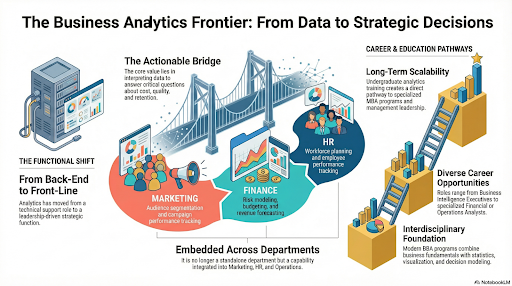
A decade ago, analytics was viewed as a specialised back-end function—handled by data teams, IT departments, or technical analysts. In 2026, that distinction has faded. Business analytics now influences marketing campaigns, supply chain design, financial planning, HR strategy, and even customer experience decisions.
Organisations increasingly operate on measurable insight rather than instinct. As a result, analytics is not a department—it is a capability embedded across functions.
This is why more students are exploring business analytics after 12th, recognising that the discipline shapes how modern businesses think, operate, and compete.
Takeaway: Analytics is no longer about numbers alone—it is about informed decision-making across the organisation.
- How business analytics connects different business functions
- Why BBA in Business Analytics is emerging as a future-focused degree
- What career opportunities exist after BBA Analytics?
- What is the salary outlook in business analytics?
- Can you pursue higher studies after BBA Analytics?
- Why the scope of analytics will continue expanding
- Conclusion
How business analytics connects different business functions
Business analytics acts as a bridge between data and action. It helps companies answer questions such as:
- Which marketing channel generates the highest return?
- How can operational costs be reduced without affecting quality?
- What customer segments show the strongest retention patterns?
- How can workforce productivity be measured and improved?
Across departments, analytics supports:
- Marketing – campaign performance tracking, audience segmentation
- Finance – budgeting, forecasting, risk modelling
- Operations – process optimisation and efficiency analysis
- HR – performance analytics and workforce planning
- Sales – revenue forecasting and customer behaviour insights
The expanding scope of analytics explains why structured programs such as an online BBA in business analytics are gaining traction among students who want early exposure to data-driven thinking.
Why BBA in Business Analytics is emerging as a future-focused degree
Undergraduate education in analytics integrates business fundamentals with quantitative reasoning. Instead of treating analytics as a technical add-on, a BBA in Business Analytics combines:
- Core business subjects (finance, marketing, management)
- Data interpretation and visualisation
- Business statistics
- Decision modelling
- Technology-enabled analysis
This combination prepares students not just to read reports, but to understand how decisions are shaped.
Institutions offering programs such as Online BBA Chandigarh University reflect this interdisciplinary approach, where analytics is embedded within management education rather than isolated.
Yes. As organisations increasingly rely on data for strategic decisions, graduates with business analytics knowledge are positioned for diverse and evolving career opportunities.
Controlled contradiction
Analytics is sometimes perceived as purely technical. In reality, its strongest value lies in business interpretation, not just data processing.
What career opportunities exist after BBA Analytics?
The scope of BBA analytics career options spans multiple industries, including IT, banking, retail, consulting, e-commerce, healthcare, and logistics.
Below are common job roles with brief explanations:
- Business Analyst
Analyses organisational data to identify trends, inefficiencies, and growth opportunities. Works closely with management teams to recommend actionable solutions. - Data Analyst
Interprets datasets to extract insights related to sales, customer behaviour, or operational performance. Often supports decision-making teams. - Marketing Analyst
Evaluates campaign performance, audience segmentation, and customer acquisition data to optimise marketing strategies. - Financial Analyst
Uses data to forecast revenue, analyse cost structures, and assess financial risks within organisations. - Operations Analyst
Focuses on improving workflow efficiency, reducing costs, and enhancing productivity through data-backed insights. - Sales Analyst
Tracks sales performance, revenue patterns, and customer conversion metrics to guide strategic sales decisions. - HR Analytics Executive
Applies data to recruitment trends, employee performance tracking, and workforce planning. - Business Intelligence (BI) Executive
Creates dashboards and visual reports that help leadership teams monitor organisational performance.
The availability of business analytics jobs in Delhi and other metropolitan hubs continues to grow as companies digitise operations and prioritise measurable growth.
Takeaway: Analytics roles differ by function, but share one core ability—translating data into business decisions.
Contact us for academic guidance
Get in TouchWhat is the salary outlook in business analytics?
Salary in analytics depends on role, organisation, and skill depth. In metropolitan regions such as Delhi, analytics roles often offer structured growth pathways, particularly in consulting, fintech, e-commerce, and corporate sectors.
Rather than focusing solely on starting salary, students should consider the long-term scalability of the field.
Entry-level salaries vary by role and city, with performance growth often linked to technical proficiency, business understanding, and industry exposure.
Can you pursue higher studies after BBA Analytics?
Business analytics at the undergraduate level creates a strong foundation for postgraduate specialisation. This pathway enables progression from technical support roles to managerial and strategic positions.
Yes. Graduates can pursue an MBA in Business Analytics, Finance, Marketing, or other management specialisations to deepen leadership and strategic skills.
Why the scope of analytics will continue expanding
As businesses adopt automation, AI integration, and digital transformation, the need for professionals who understand both business fundamentals and analytical reasoning will intensify.
Analytics is moving from:
- Support function → Strategic function
- Reporting role → Decision-driving role
- Back-end task → Leadership capability
Students who begin exploring business analytics after 12th position themselves within a discipline that intersects management, technology, and strategy.
Conclusion
The scope of business analytics now extends across nearly every organisational function, making it one of the most versatile domains in modern business education. A BBA in Business Analytics equips students with both managerial understanding and data-driven reasoning, preparing them for roles that influence strategic decision-making rather than merely execute tasks.
As industries continue to digitise and prioritise measurable outcomes, the demand for professionals who can interpret data within business contexts will only grow. For students seeking a degree that blends adaptability, relevance, and long-term career scalability, business analytics represents a forward-looking academic and professional pathway.