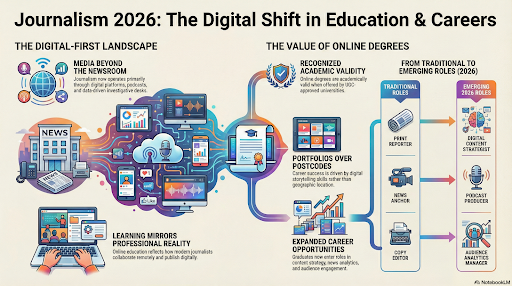
Journalism in 2026 is no longer confined to newsrooms, print editions, or television studios. It operates across digital platforms, independent media portals, podcasts, video-first channels, and data-driven investigative desks. News cycles move in minutes, audiences engage interactively, and credibility is constantly tested.
In this environment, the question is not simply whether journalism is a viable career, but whether an online journalism degree can prepare learners for an industry that is itself digital.
The structure of journalism education must now reflect the structure of media consumption. As reporting shifts to digital-first platforms, learning models that mirror this ecosystem gain relevance.
Takeaway: When journalism becomes digital by default, the learning format cannot remain analogue in mindset.
- How is journalism education evolving in India?
- Is an online journalism degree academically valid?
- What does an online BA in Journalism actually teach?
- What jobs can you get after a BA in Journalism?
- How does location still influence journalism careers?
- Is online journalism suitable for career growth in 2026?
- What should students consider before enrolling?
- Conclusion
How is journalism education evolving in India?
The growth of digital media has reshaped the journalism career scope across India. Traditional reporting roles continue, but new opportunities have emerged in:
- Digital content strategy
- Investigative multimedia reporting
- Data journalism
- Podcast production
- Social media editorial roles
- News analytics and audience engagement
As a result, the idea of a journalism course online in India is no longer unconventional. It aligns with how journalists now work—collaborating remotely, publishing online, and engaging audiences digitally.
Yes. Students can pursue a journalism course after 12th through structured online bachelor's programs offered by recognised universities.
Is an online journalism degree academically valid?
Concerns around recognition are common, especially in media studies where credibility is central. Validity depends on institutional recognition and regulatory compliance—not on the delivery format itself.
Journalism values field exposure and newsroom interaction. Yet, much of today's journalism happens digitally. Online programs that integrate digital reporting tools may sometimes mirror industry reality more closely than purely classroom-based formats.
Yes. An online journalism degree is valid when it is offered by a recognised university under UGC-approved regulations governing online education.
What does an online BA in Journalism actually teach?
A well-designed online journalism program typically includes:
- News writing and reporting
- Media ethics and law
- Digital journalism tools
- Video and multimedia production
- Communication theory
- Editing and content development
Programs such as the BA Mass Communication Online at Chandigarh University reflect how institutions are integrating digital learning with journalism fundamentals. The goal is not only to teach writing, but to build media literacy, ethical judgement, and storytelling competence.
Takeaway: Journalism education must balance credibility, creativity, and digital fluency.
What jobs can you get after a BA in Journalism?
The more relevant factor in 2026 is skill adaptability. Journalists who combine writing with video editing, data analysis, or digital strategy often accelerate their earning potential. The range of BA Journalism jobs has expanded significantly beyond conventional reporting.
In metropolitan hubs like Delhi, opportunities in digital media platforms, broadcasting houses, and corporate communication teams continue to grow. This explains why searches for journalism jobs in Delhi remain high. Salary varies depending on role, organisation, and skill level.
Graduates can work as reporters, content writers, digital editors, media researchers, social media managers, news producers, or communication executives.
Entry-level salaries vary by role and organisation, with digital media and content-based roles often offering structured growth based on performance and skill development.
How does location still influence journalism careers?
Students exploring Journalism Colleges in Chandigarh or looking at a Mass Communication Course in Punjab often consider regional media ecosystems. While location can influence networking and internships, online education reduces geographic limitations.
A student studying online can:
- Intern with digital media houses remotely
- Publish independently on digital platforms
- Build a portfolio without a physical newsroom attachment
This shift weakens the historical dependency on campus location.
Get in touch with our academic team for further clarification.
Contact UsTakeaway: In digital journalism, your portfolio often matters more than your postcode.
Is online journalism suitable for career growth in 2026?
The core question is not whether the degree is online, but whether it prepares students for the real dynamics of contemporary media. The worth of an online journalism degree depends on how it integrates:
- Digital storytelling tools
- Media ethics
- Industry awareness
- Portfolio-building opportunities
When these components are structured well, the degree supports both employability and professional identity formation.
What should students consider before enrolling?
Students should evaluate:
- University recognition
- UGC approval status
- Curriculum relevance to digital media
- Internship or project components
- Faculty and mentorship structure
Institutions such as Chandigarh University illustrate how universities structure online mass communication programs within regulated academic frameworks, ensuring both validity and contemporary relevance.
Conclusion
In 2026, the value of an online journalism degree depends less on its format and more on its alignment with the realities of the media industry. As journalism becomes increasingly digital, multimedia-driven, and audience-centric, learning models that incorporate online tools, digital workflows, and portfolio development gain strategic relevance. When offered by recognised institutions under UGC-approved frameworks, an online journalism degree can provide academic validity alongside practical industry alignment.
For students seeking flexibility without compromising credibility, the decision should be guided not by tradition but by how effectively the program prepares them for the evolving landscape of journalism and media careers in India.