In recent years, online degree courses in India have become one of the most trusted academic pathways for students and professionals seeking UGC-recognised qualifications without leaving their jobs or cities. These programs are offered by universities authorised under the UGC (Online Education) Regulations, allowing learners to pursue bachelor’s and master’s degrees through a digital learning platform.
Unlike short-term certifications, an online degree is a full-fledged academic qualification, equivalent in value to its on-campus counterpart. It covers structured coursework, recorded and live lectures, e-study material, assignments, and proctored online examinations.
Key takeaway: Online degrees combine credibility, accessibility, and professional growth, making them a preferred choice for working individuals, homemakers, and fresh graduates alike.
UGC Regulations for Online Degrees
The University Grants Commission (UGC) introduced clear guidelines in 2018 and later revised them in 2020 to formalise the structure of accredited online degree programs in India.
Under these regulations:
- Only universities accredited by NAAC (A+ or above) and having existed for at least five years are eligible to offer online degrees.
- Courses must align with existing syllabi approved for regular programs.
- The delivery includes a Learning Management System (LMS) that hosts live lectures, recorded videos, study modules, and digital assessments.
- Online degrees are recognised for employment and higher education in both government and private sectors.
Yes, as long as the program is UGC-DEB approved and offered by a recognised institution, it holds the same validity as a regular on-campus degree for jobs, UPSC, and higher education.
Key takeaway: Always verify a university’s UGC-DEB accreditation on the official UGC portal before applying.
Top Online Degree Courses in India
Online degrees span across disciplines — from arts and commerce to management and technology. Here’s a breakdown of the most popular programs:
-
Online Bachelor of Arts (BA)
An online bachelor’s degree in Arts develops a broad understanding of the humanities, economics, and political systems. Ideal for students interested in civil services, education, or social sciences, this degree helps build analytical and communication skills. -
Online BBA
The online bachelor degree in India for Business Administration is designed for future managers. It includes fundamentals of marketing, human resources, business analytics, and entrepreneurship, making it a career-launching course for corporate aspirants. -
Online BCA
An online bachelor course in Computer Applications focuses on programming, data management, and emerging technologies like AI and cloud computing. It’s ideal for students planning to pursue MCA or IT careers. -
Online MBA
A master’s degree online India in Business Administration opens opportunities in marketing, finance, HR, operations, and leadership roles. Most universities provide project-based learning and industry mentorship. -
Online MCA
For those with a tech background, the online master degree courses in India in Computer Applications offer deep technical training in data analytics, software engineering, and system design.
MBA, MCA, and BBA programs are most suited for working individuals, as they align academic knowledge with real-time industry applications.
Key takeaway: Choose your online degree based on your long-term career plan — not just convenience.
Curious to Know More?
Get in TouchEligibility Criteria & Admission Process
The online degree admission process is straightforward and digital.
Eligibility:
- For bachelor’s programs (BA, B.Com, BBA, BCA): completion of 10+2 or equivalent from a recognised board.
- For master’s programs (MBA, MCA): a recognised bachelor’s degree in any discipline.
Admission Steps:
- Visit the university website and fill out the online application form.
- Upload educational documents and identity proof.
- Pay the registration and program fee online.
- Upon verification, receive confirmation and LMS login credentials.
Generally, 10th and 12th mark sheets, a graduation certificate (for PG), ID proof, and a passport-size photo are required.
Key takeaway: Ensure all uploaded documents are self-attested and in the correct format to avoid admission delays.
Fees for Online Degrees
The average fees for online degree courses in India vary by university, program, and duration:
| Program | Duration | Average Fee (₹) |
|---|---|---|
| Online BA / B.Com / BBA | 3 years | ₹12,000 – ₹25,000 per year |
| Online BCA | 3 years | ₹20,000 – ₹45,000 per year |
| Online MBA | 2 years | ₹40,000 – ₹1,20,000 total |
| Online MCA | 2 years | ₹45,000 – ₹1,30,000 total |
Fees often include digital learning resources and examination charges.
Most universities charge between ₹15,000 and ₹1,20,000 depending on the course and duration.
Key takeaway: Online degrees are cost-effective alternatives to traditional programs, offering equal academic recognition at a lower cost.
Online Degree vs Regular Degree: What’s Better?
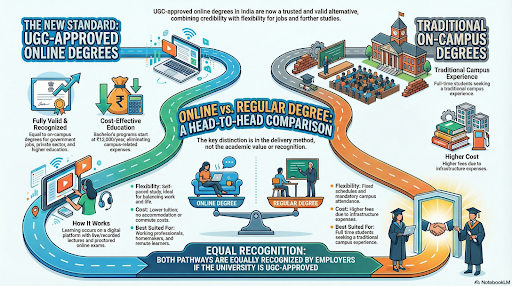
When comparing online degree courses in India with traditional on-campus programs, the key distinction lies in delivery, not value. Both are equally recognised by UGC and hold the same academic weight for employment or higher education. However, their learning experience and accessibility differ significantly.
| Criteria | Online Degree | Regular Degree |
|---|---|---|
| Mode of Learning | Conducted through a digital platform (LMS) with live and recorded lectures, e-books, and online assessments. | Conducted physically on campus with fixed class schedules. |
| Recognition | Fully valid if offered by a UGC-DEB-approved university. | Valid under UGC norms for traditional institutions. |
| Flexibility | Ideal for working professionals and remote learners; allows self-paced study. | Fixed timetable and attendance requirements; best suited for full-time students. |
| Cost Structure | Generally lower; includes digital resources, no hostel or commute costs. | Higher due to infrastructure and accommodation expenses. |
| Skill Integration | Encourages digital literacy, self-management, and online collaboration — essential for today’s job market. | Builds interpersonal and presentation skills through physical interactions. |
| Examination Pattern | Online proctored or hybrid (digital + project-based evaluation). | Offline exams are conducted at campus centres. |
| Peer & Faculty Interaction | Through discussion forums, webinars, and virtual sessions. | In-person classroom engagement and networking. |
| Career Value | Equal acceptance in the corporate and government sectors if the program is UGC-approved. | Widely accepted across sectors. |
| Best Suited For | Working professionals, entrepreneurs, homemakers, and students need flexibility. | Full-time learners seeking a campus experience. |
Key takeaway: If your goal is skill-building, upskilling, or balancing education with work, an online degree provides unmatched flexibility and the same recognition as a regular one.
How to Choose the Best University
Selecting the right institution is crucial to ensuring the long-term value of your accredited online degree programs.
Steps to make an informed decision:
- Check UGC-DEB approval: Verify the program on the official UGC portal.
- Review NAAC grades: Choose universities with an A or A+ accreditation.
- Compare program structure: Look for interactive LMS, live sessions, and continuous assessments.
- Assess career support: Prefer universities that offer placement or internship assistance.
- Read learner reviews: Alumni feedback can reveal teaching quality and responsiveness.
Among India’s leading online universities, Chandigarh University stands out for its UGC-approved online programs, advanced learning platform, and strong learner support. Other reputed institutions include Jain University, Amity University, and Manipal University Jaipur — all offering high-quality online education options.
Key takeaway: Prioritise accreditation, technology, and learner support when choosing your online university.
Career Opportunities after an Online Degree
An online bachelor's or master's degree in India opens a pathway to both corporate and public-sector careers. The value of an online degree lies in its recognition and skill alignment — making graduates competitive across industries.
Let’s explore potential job roles based on popular disciplines:
- BA (Bachelor of Arts) – Communication, Civil Services, and
Education
Graduates with an online BA can pursue careers in:
- Content Writing / Digital Communication: Ideal for those skilled in English, media, or political science.
- Teaching / Academic Counselling: Opportunities in e-learning firms, NGOs, and online tutoring platforms.
- Civil Services Preparation: Many aspirants use a BA as a foundation for UPSC, State PSC, or SSC exams.
Takeaway: Online BA programs nurture critical thinking and analytical skills valuable for government and policy-driven roles. - BBA (Bachelor of Business Administration) – Management and
Marketing
The BBA degree opens entry-level management roles such as:
- Marketing Executive: Creating and executing promotional strategies.
- HR Associate: Managing recruitment and employee engagement processes.
- Operations Coordinator: Handling logistics, supply chain, and administrative functions.
Takeaway: BBA graduates from UGC-approved online programs often secure fast-track promotions through the real-time application of business concepts. - BCA (Bachelor of Computer Applications) – IT and Data Roles
Technology-oriented careers for online BCA graduates include:
- Software Developer / Programmer: Building and testing code for applications.
- Data Analyst: Managing and interpreting datasets for business insights.
- Technical Support Engineer: Providing system and network troubleshooting solutions.
Takeaway: The program bridges coding, data, and analytics skills, making it a powerful entry point to the tech industry. - MBA (Master of Business Administration) – Leadership and Strategy
Online MBA holders can advance into mid-level and senior roles, such as:
- Business Development Manager: Driving sales growth and strategic partnerships.
- Financial Analyst: Evaluating company performance and investment decisions.
- Project Manager: Leading cross-functional teams and delivering results.
Takeaway: Online MBA programs focus on applied leadership and problem-solving — attributes highly valued in modern management roles. - MCA (Master of Computer Applications) – Software and System
Architecture
For tech professionals, an MCA opens high-demand IT roles like:
- Software Engineer / Full Stack Developer: Designing end-to-end digital solutions.
- Database Administrator: Managing and securing enterprise data systems.
- System Analyst: Translating business needs into technology-driven models.
Takeaway: An MCA online degree enhances career stability in the growing digital ecosystem and positions graduates for global IT opportunities.
Yes. UGC-DEB-recognised online degrees are valid for government and PSU roles, as well as for higher education or competitive exams.
Key takeaway: Whether your goal is career entry, job change, or promotion, accredited online degrees provide recognised credentials for both private and public sectors.
Final Thoughts
Online education in India is entering a golden phase — recognised, structured, and future-ready. With multiple accredited options, transparent admissions, and growing industry trust, online degree courses are no longer an alternative but an equal route to academic and career success.
If you’re planning your next academic move, explore UGC-approved universities, compare program features, and choose the course that aligns with your career vision.