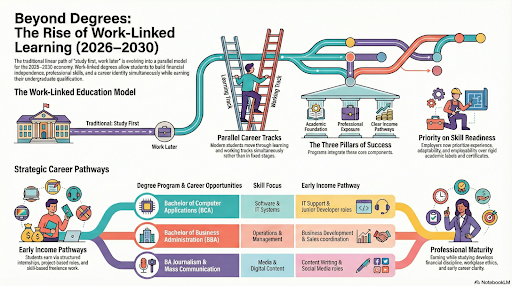
The years ahead will redefine how young people enter the workforce. The traditional path of studying first and earning later is steadily giving way to a new model — one where learning and earning happen together. For students completing Class 12 today, the question is no longer just what to study, but how early they can start building financial independence, skills, and career stability.
Between 2026 and 2030, industries will prioritise:
- skill readiness over certificates
- experience over theory
- adaptability over rigid qualifications
- employability over academic labels
These are not short-term training courses. They are structured undergraduate degrees designed to integrate academic learning with professional work experience — allowing students to build income, skills, and career identity simultaneously.
- The New Education Model: Learning and Earning Together
- Why “Earn While You Learn” Matters in the 2026–2030 Economy
- Work-Linked Programs: The Career Advantage Model
- Science vs Commerce vs Arts: Best Work-Linked Earning Courses After 12th (2026–2030)
- Why These Courses Are Career-Relevant (Not Just Degree-Relevant)
- Learning Formats and Digital Integration
- Income Pathways During Study
- Psychological Impact of Earning While Studying
- Career Design for 2026–2030 Students
- FAQs
- Strategic Takeaway
The New Education Model: Learning and Earning Together
Modern career pathways are no longer linear. Students no longer move from education → job →
growth in fixed stages. Instead, they move through parallel tracks:
- learning + working
- studying + earning
- education + industry exposure
- theory + application
Students today want:
- early income security
- career clarity
- skill confidence
- professional exposure
- financial independence
- employability before graduation
This has changed how career options after 12th are evaluated — from “best degree” to best career pathway.
Why “Earn While You Learn” Matters in the 2026–2030 Economy
The future workforce will reward people who:
- learn continuously
- adapt quickly
- understand industry systems
- work in real environments
- build professional discipline early
Work-linked education models offer:
- financial support during education
- early career confidence
- professional maturity
- reduced dependency after graduation
- stronger employability outcomes
This is not about part-time jobs — it’s about structured career integration.
Work-Linked Programs: The Career Advantage Model
Unlike traditional degrees or short certifications, work-linked programmes are designed around three pillars:
- Academic Foundation – structured degree learning
- Professional Exposure – real work environments
- Income Pathways – earning opportunities during study
This model creates students who graduate with:
- qualifications
- experience
- income history
- industry familiarity
- employability confidence
This is the foundation of job oriented courses after 12th for the future workforce.
Science vs Commerce vs Arts: Best Work-Linked Earning Courses After 12th (2026–2030)
(Earn While You Learn Model)
| Stream | Work-Linked Degree Program | Skill Focus Area | Early Income Pathways | Long-Term Career Growth |
|---|---|---|---|---|
| Science | Bachelor of Computer Applications (BCA) | Software, IT systems, digital tools | IT support roles, junior developer roles, tech freelancing, and data handling work | Software careers, tech leadership, digital entrepreneurship |
| Commerce | Bachelor of Business Administration (BBA) | Business operations, management, sales | Business development roles, sales coordination, operations support | Management careers, leadership roles, and enterprise growth |
| BBA (Business Analytics) | Data interpretation, analytics, business intelligence | Data assistant roles, reporting roles, analytics support functions | Analytics leadership, strategy roles, digital business careers | |
| Arts | Bachelor of Arts – Journalism & Mass Communication | Media production, communication, digital content | Content writing, social media roles, media production support | Media leadership, digital communication careers, and content entrepreneurship |
Wondering which program best suits you?
Get in Touch with Our CounsellorsWhy These Courses Are Career-Relevant (Not Just Degree-Relevant)
These programmes are built around market demand, not academic tradition.
They focus on:
- employable skills
- income-generating capabilities
- professional exposure
- industry readiness
- practical competence
- career scalability
This is what makes them true career options after 12th, not just educational choices.
Learning Formats and Digital Integration
Today’s students are also exploring online courses after 12th, but the future is not about
format alone — it’s about career integration.
Modern learning models include:
- digital academic delivery
- blended learning systems
- work-linked academic structures
- industry-integrated programmes
- applied learning ecosystems
What matters is not whether learning is online or offline — but whether it creates income pathways and career readiness.
Income Pathways During Study
Students in work-linked programmes typically earn through:
- internships
- structured work placements
- project-based roles
- part-time professional assignments
- skill-based freelance work
- industry-aligned support roles
This creates early financial independence and career maturity — something traditional degrees do not offer.
Psychological Impact of Earning While Studying
Students who earn while studying develop:
- financial discipline
- professional confidence
- responsibility
- career clarity
- long-term planning mindset
- workplace ethics
These traits shape not just careers — but identity, decision-making, and leadership behaviour.
Career Design for 2026–2030 Students
The future workforce will not reward:
- passive degrees
- delayed employability
- experience gaps
- purely academic learning
It will reward:
- skill ownership
- career clarity
- work readiness
- adaptability
- early professional exposure
Work-linked programmes align directly with this reality.
FAQs
By enrolling in work-linked degree programmes that integrate academic learning with structured work opportunities, students can earn through internships, placements, and professional roles during their studies.
Courses that combine academic degrees with industry exposure — such as BCA, BBA, BBA (Business Analytics), and BA Journalism & Mass Communication — offer early earning opportunities through work-linked models.
Yes. With skill-based learning and work-linked education models, students can enter professional roles while pursuing their degree.
Choose structured work-linked undergraduate programmes that allow you to gain qualifications, experience, and income simultaneously.
Yes. Recognised online and digital degrees are valid for employment when they are institutionally approved and aligned with regulatory standards.
Strategic Takeaway
The future of education is not about choosing between studying or earning. It is about
choosing pathways that allow you to do both together.
Between 2026 and 2030, students who succeed will be those who:
- Build skills early
- Enter work environments young
- Earn while learning
- Gain experience before graduation
- Develop career clarity
- Achieve financial independence sooner
In the coming decade, the most powerful advantage will not be the degree you hold — but the experience, income, and skills you build while earning it.